


Introduction
In Kenya, the Prado is more than just an SUV; it is a statement of reliability, capability, and sometimes, necessary infrastructure.
We rely on the Toyota brand for durability, especially for tackling rough terrain and upcountry roads, but this robustness comes with a significant consideration: fuel economy.
Unlike smaller crossovers, the heavy-duty body-on-frame construction and powerful engines required for a vehicle of this size mean consumption figures will naturally be higher.
For Kenyan buyers, calculating the cost of ownership isn’t just about the initial purchase price and import duties; it’s about the monthly fuel bill, which can quickly become the single largest recurring expense, making a detailed understanding of the true prado fuel consumption per km indispensable before committing to the investment.
Many potential buyers are often misled by manufacturer figures provided for optimal, laboratory conditions, which simply do not reflect the reality of Kenyan driving—think stop-and-go traffic on Waiyaki Way, high altitude sections, and the frequent need for low-range gear use off-tarmac.
When importing a high-value vehicle like the Prado, transparency regarding its mechanical history is paramount, as a poorly maintained or high-mileage engine will consume significantly more fuel than expected, eating into your budget unnecessarily.
This is precisely why dealing with experienced importers like Enan Motors, who provide verified auction sheets from Japan, allows buyers to anticipate true running costs based on genuine engine condition and mileage, giving you confidence long before the car hits the port of Mombasa.

Understanding Fuel Consumption Metrics
Globally, fuel consumption is measured in several ways, often leading to confusion for local buyers.
The most common metrics include Litres per 100 Kilometers (L/100km), which is the standard used in Europe and often cited on import documents, and Kilometers per Litre (Km/L), which is the standard calculation metric most Kenyans use daily to track their fuel efficiency.
For example, if a manufacturer quotes 8.5 L/100km, this equates roughly to 11.7 Km/L, which seems excellent on paper, but these figures rarely hold true in our localized operating environment due to factors like lower quality fuel and frequent low-speed maneuvering.
We strongly recommend always converting the stated consumption rate into Km/L and then applying a 15–20% real-world penalty, especially for city driving, to get a realistic estimate of the Prado fuel consumption per km you will experience.
The key challenge in Kenya lies in the specific engines commonly imported.
The popular 3.0L 1KD-FTV diesel engine (found in the J120 and earlier J150 models) has robust power but is generally less efficient than the newer, smaller capacity 2.8L 1GD-FTV diesel engine found in later J150 models (2015 onwards).
While the 1GD-FTV uses more advanced technology like common rail injection and variable geometry turbos to achieve better economy, vehicles with either engine often have had their Diesel Particulate Filters (DPFs) removed locally to cope with perceived poor fuel quality, a modification that can negatively impact performance and overall efficiency, even if it solves a maintenance headache.
Understanding these engine specifics and verified service history is crucial, and Enan Motors ensures clients know exactly which engine variant they are purchasing and its condition via authenticated documentation.
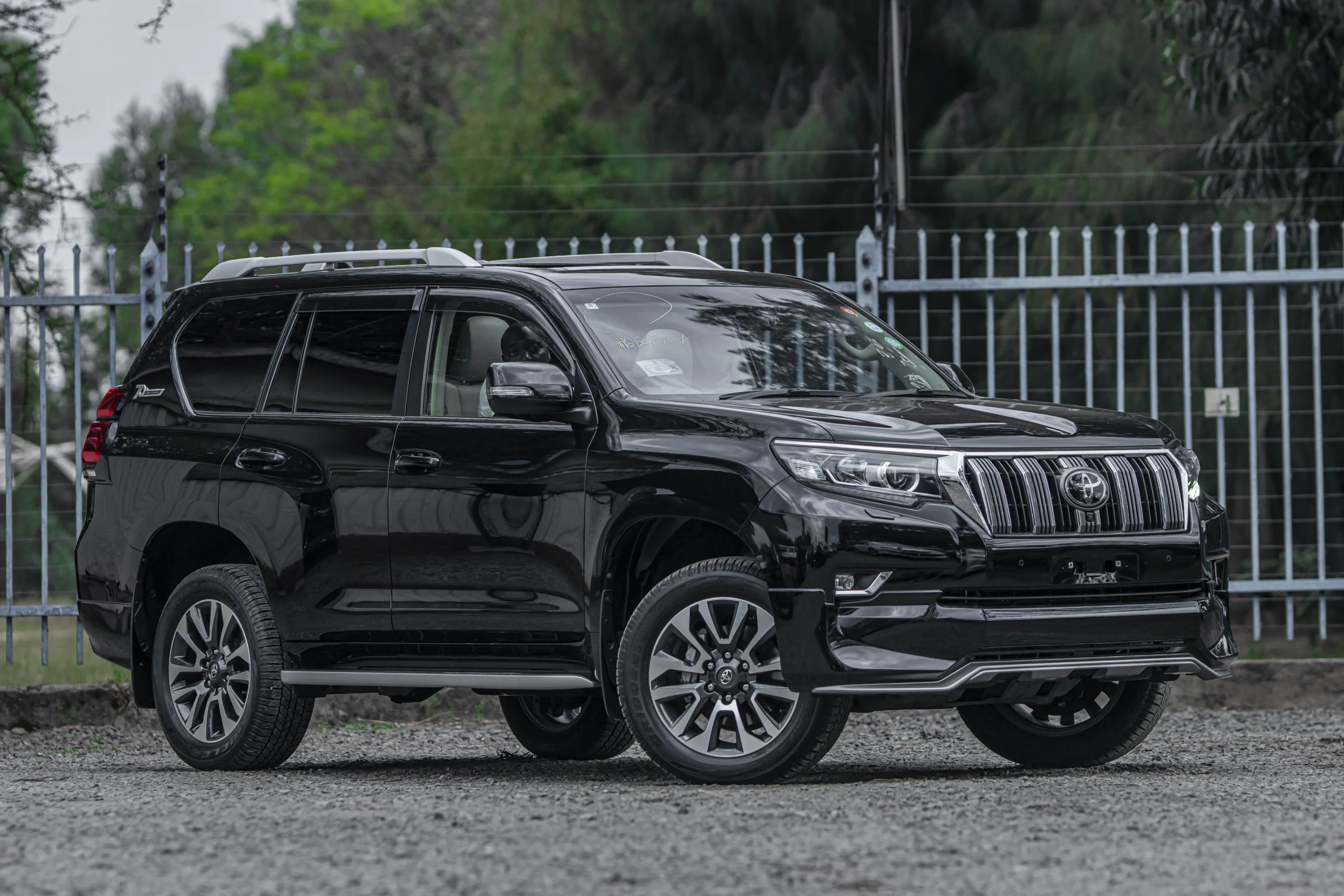
Real-World Prado Fuel Consumption per km
Based on our practical experience running these vehicles across the Kenyan landscape, we can provide segmented consumption expectations for the popular 150 series.
In heavy urban Nairobi traffic, expect the 3.0L diesel Prado to hover around 8.5 Km/L, sometimes dipping lower depending on the severity of the gridlock, while the newer 2.8L diesel can achieve 9.5 Km/L.
Highway cruising, where the vehicle settles into its optimal gear, sees a significant improvement, with the 3.0L reaching 10.5–11 Km/L and the 2.8L comfortably hitting 11–12 Km/L.
It is critical to note that older J120 models (often equipped with the 1KZ-TE diesel or V6 petrol) will inherently offer poorer consumption, sometimes falling below 7 Km/L in mixed driving, which makes them less desirable for routine commuting in the current high-fuel-cost environment.
When you are looking to import, knowing the exact grade and specification available in Japan provides a huge advantage in predicting your operational expenditure.
For instance, a basic grade model without heavy roof racks or significant aftermarket accessories will inherently be lighter and more efficient than a full-spec version loaded with optional extras common in local yards.
We guide clients through selecting specific auction units that match their consumption goals, confirming that the engine performance scores on the Japanese auction sheets are high before bidding.
This level of transparency means you aren’t guessing the prado fuel consumption per km; you are calculating it based on verified data, unlike the uncertainty that often accompanies buying locally sourced used vehicles whose history is unknown.

Key Factors Influencing Prado Fuel Efficiency
Beyond the inherent engine design, several practical factors common to the Kenyan driving environment drastically impact the Prado’s efficiency.
Firstly, maintenance is paramount; delaying oil changes, using incorrect viscosity lubricants, or driving with clogged air and fuel filters can easily knock 1 Km/L off your expected efficiency, particularly affecting vehicles that operate in dusty conditions upcountry.
Secondly, the excessive idling caused by prolonged traffic jams in major cities means the vehicle consumes fuel without covering distance, pushing the average Km/L figure down significantly during weekly commutes.
We advise clients to be meticulous with servicing, ensuring that all components are functioning optimally, which helps the vehicle maintain peak performance and achieve the best possible prado fuel consumption per km.
Thirdly, aftermarket accessories and load capacity play a huge role.
Many Kenyan Prado owners install bullbars, heavy-duty suspension, auxiliary lighting, and permanent roof racks, significantly increasing the vehicle’s drag and overall weight.
Carrying unnecessary heavy items, like tools, spare parts, or water tanks permanently in the boot, continually forces the engine to work harder, directly impacting fuel use.
Furthermore, driving style is non-negotiable; aggressive acceleration and heavy braking in traffic waste fuel dramatically.
Driving smoothly and anticipating traffic flow, a technique known as hypermiling, can result in significant savings, often improving consumption figures by 10% or more, proving that the driver’s input is just as important as the car’s mechanical condition.

Comparing Prado Fuel Consumption with Competitors
While the Prado is the king of the Kenyan SUV market, potential buyers often consider alternatives, particularly when fuel consumption is the primary deciding factor.
Comparing the Prado’s 8.5–11.5 Km/L average against other heavy 4x4s, it performs competitively.
A similarly sized Mercedes GLE or BMW X-series, while technologically advanced, often requires high-octane fuel and demanding maintenance schedules, sometimes leading to unexpectedly high running costs despite marginally better headline efficiency figures.
On the other hand, the Prado is certainly less efficient than smaller, more car-like SUVs popular for city use, such as the Mazda CX 5 or Honda Vezel, which routinely achieve 14–18 Km/L.
However, the comparison is often unfair, as the Prado offers true off-road capability and legendary reliability that smaller crossovers cannot match.
If your usage involves rough roads, long distance trips, or towing, the Prado’s robust engineering justifies the fuel premium.
For those seeking a direct competitor in the heavy 4×4 segment, models like the Mitsubishi Pajero (Shogun) or the Volkswagen Tiguan (which is smaller but capable) often offer slightly varied consumption figures, but they rarely match the Toyota’s proven resale value and ease of spare parts access in Kenya.
When importing through Enan Motors, we help you weigh the marginal differences in prado fuel consumption per km against the total cost of ownership, helping you select the best vehicle for your specific needs, whether that is maximizing economy or maximizing ruggedness.

Practical Tips to Reduce Prado Fuel Consumption
Optimizing your Prado’s fuel consumption starts with regular, quality maintenance.
Ensure your tyres are consistently inflated to the manufacturer’s specified pressure; under-inflated tyres increase rolling resistance, forcing the engine to work harder and dramatically reducing efficiency.
Furthermore, consider optimizing your air conditioning usage; running the AC constantly in heavy traffic puts a continuous parasitic load on the engine.
While necessary for comfort in the Kenyan heat, turning it off for short periods or setting the climate control conservatively can save fuel, especially when stopped or idling, which is particularly relevant for the high density of drivers in urban areas.
Another often overlooked tip is to streamline your vehicle.
If you installed a heavy-duty roof rack for a specific upcountry trip, remove it when you return to city driving.
That empty roof rack drastically increases aerodynamic drag, forcing the engine to push against unnecessary resistance, thereby increasing the prado fuel consumption per km dramatically, often by 5–10%.
Finally, use high-quality, trusted fuel.
While cheaper fuel might save a few shillings per litre upfront, poor-quality fuel can clog injectors and reduce engine efficiency over time, leading to higher maintenance costs and consistently worse mileage.
We encourage strict adherence to service schedules to keep your Japanese-imported Prado performing exactly as it was designed to.

The Enan Motors Advantage: Guaranteed Quality for Better Efficiency
One of the hidden costs that affects local used car purchases is unknown mileage and poor maintenance history, both of which severely degrade engine efficiency and worsen fuel consumption.
When you choose direct importation through Enan Motors, this risk is eliminated because every vehicle is purchased based on detailed, verified Japanese auction sheets.
These reports certify the genuine mileage, confirm the overall grading (e.g., Grade 4 or higher), and often detail recent service history, giving you complete confidence in the engine’s condition and its ability to achieve optimal prado fuel consumption per km.
We ensure that our clients select vehicles that have been well cared for in Japan, which translates directly to lower running costs and higher reliability here in Kenya.
Buying directly from the Japanese auctions also means you have access to thousands of units, allowing you to select the exact specification—whether it’s the highly efficient 2.8L diesel or a specific trim level—rather than settling for the limited and often marked-up stock found in local car yards.
This comprehensive selection, coupled with our transparent pricing structure, ensures you get a superior vehicle without paying the massive markups associated with yard overheads.
If you are ready to find a reliable, fuel-efficient Prado, free from questionable local history, explore our available cars today, or start the simple Import process by giving us a call.
We handle everything from the auction house in Japan to KRA registration here in Nairobi, offering a seamless and secure experience.

Conclusion
The Toyota Land Cruiser Prado remains an invaluable asset on Kenyan roads, balancing rugged capability with acceptable on-road comfort.
While its fuel consumption figures (averaging 8.5–11.5 Km/L) are higher than smaller SUVs, careful purchasing decisions and meticulous maintenance can keep running costs manageable.
The critical factor is transparency: knowing the true condition and history of your engine is the best predictor of real-world fuel economy.
By choosing to import directly from Japan with trusted partners like Enan Motors, you gain access to verified auction data that guarantees the quality of the vehicle, ensuring your Prado operates efficiently and reliably.
Stop guessing about the true prado fuel consumption per km and start importing with confidence; you can Call us or Message us on WhatsApp for a consultation today.
FAQ
- Is the diesel or petrol Prado more fuel-efficient in Kenya?
The diesel variants (especially the 2.8L 1GD engine) are significantly more fuel-efficient than the petrol V6 variants under typical Kenyan driving conditions, offering better low-end torque for city and off-road driving.
- How does high mileage affect Prado fuel consumption?
High mileage, especially if maintenance has been neglected, degrades injector and turbo performance, which can reduce fuel efficiency by up to 15–20% compared to a well-maintained, low-mileage unit.
- What is the typical fuel tank range for a full tank in a Prado 150?
Given the large 150-litre tank capacity (main and sub-tanks combined on many models) and an average consumption of 10 Km/L, a full tank can typically provide a range of 1,300 to 1,500 kilometres on highway journeys.
- Does using 4×4 mode increase the prado fuel consumption per km?
Yes, engaging 4×4 mode (especially full-time 4WD or low range) increases resistance and parasitic losses, resulting in higher fuel consumption, which is why it should only be used when necessary off-road.
- Why are direct imports often more fuel-efficient than local yard cars?
Direct imports usually have verified low mileage and genuine service records from Japan, guaranteeing mechanical health that translates directly to better factory-specified fuel economy, unlike local yard cars with questionable history.